
-
-
-

The Governance & Culture Reform hub is designed to foster discussion about corporate governance and the reform of culture and behavior in the financial services industry.

Need to file a report with the New York Fed? Here are all of the forms, instructions and other information related to regulatory and statistical reporting in one spot.

The New York Fed works to protect consumers as well as provides information and resources on how to avoid and report specific scams.
-
-
-

The New York Fed provides a wide range of payment services for financial institutions and the U.S. government.

The New York Fed offers the Central Banking Seminar and several specialized courses for central bankers and financial supervisors.

The New York Fed has been working with tri-party repo market participants to make changes to improve the resiliency of the market to financial stress.
-
-
-

We are connecting emerging solutions with funding in three areas—health, household financial stability, and climate—to improve life for underserved communities. Learn more by reading our strategy.

The Economic Inequality & Equitable Growth hub is a collection of research, analysis and convenings to help better understand economic inequality.
The Governance & Culture Reform hub is designed to foster discussion about corporate governance and the reform of culture and behavior in the financial services industry.
-



| Recapping an article from the November 2002 issue |
|
|
| of the Economic Policy Review, Volume 8, Number 2 | View full article  |
|
|
|
13 pages / 149 kb | |
|
Author: Bart Hobijn |
Disclaimer | |
| Index of executive summaries |
|
Overview The author evaluates how increased spending on security measures in the aftermath of 9/11 could affect the U.S. economy. He concludes that concerns over excessively large public and private sector expenditures or severe declines in private sector productivity are ill-founded. Direct government and private sector spending, Hobijn estimates, will be fairly modest in 2003 and will account for a relatively small share of GDP, while labor productivity levels will decline only slightly. Furthermore, the indirect costs of heightened homeland security measures—such as those associated with longer waits at airports and a reallocation of research and development (R&D) spending—should not be significant. Background Efforts to improve the security precautions and response capabilities of the government and private firms after 9/11 could have major effects on the economy. Excessive federal, state, and local spending on homeland security, for example, could cast doubt on the fiscal discipline of the government. In addition, overall productivity in the private sector could suffer if firms devote large-scale resources to protecting their operations. Homeland security could also have an indirect economic impact, felt, for example, through the costs arising from increased airport waiting times and the diversion of R&D spending from productivity-enhancing technologies to protection. Argument and Methodology Hobijn quantifies the direct and indirect costs of the homeland security initiatives. He acknowledges that because it is difficult to classify these costs, he employs a very broad definition of them: all expenditures possibly aimed at preventing damage due to terrorist attacks or preparing for potential attacks. From this perspective, the study addresses three central questions, beginning with the likely magnitude of government expenditures on security. To explore this question, Hobijn compares historical and proposed expenditures on homeland security by the federal, state, and local governments with historical spending levels on other programs. The study then considers whether firms will allocate sizable amounts of time and money to protection. Here, Hobijn estimates the shares of capital and labor that firms devoted to protection before 2001 ("inputs") and considers how doubling these shares would affect firm productivity levels. Finally, the author evaluates two important indirect effects of homeland security: the costs linked to longer wait times at airports and the impact that a shift in firms' R&D expenditures could have on long-run productivity growth. Findings Hobijn concludes that homeland security's economic costs to the public sector will be relatively small. Expenditures by the federal government will likely total $38 billion in fiscal year 2003, or 0.35 percent of GDP (chart). This percentage represents a tripling from 1996 of nondefense expenditures as a share of GDP. Nevertheless, when one adds homeland security spending to national defense spending, the overall 3.8 percent share of GDP roughly equals the share for 1995 and is still less than any share posted between 1947 and 1994 (chart). Net spending by state and local governments on homeland security should total about $1.3 billion in 2003, a small expense when viewed in light of the $1,276 billion in total state and local expenditures in 2001. Hobijn likewise concludes that homeland security will have a modest effect on productivity in the private sector. Even after a hypothetical doubling of security-related capital and labor inputs, he finds that the largest effect—that on labor productivity—lowers labor productivity by at most only 1.12 percent. The author calculates a $32.8 billion cost from doubling these security-related inputs to productivity. Adding to this amount the federal, state, and local expenditures on homeland security, he arrives at a public and private sector spending total of a relatively small $72 billion, or 0.66 percent of 2003 GDP (table). The indirect costs of homeland security are also found to be modest. According to Hobijn, the annual value of time lost by business and leisure travelers because of airport delays in 1999 was $11.8 billion. This figure—which is a useful proxy for security-related delays—is less than the $12.5 billion regional cost of congestion in the Los Angeles area. It is also at the lower end of an $8 billion-to-$32 billion range reported in a recent study on the costs of terrorism. Furthermore, Hobijn concludes that research and development spending on homeland security will have little long-term impact on productivity growth. Citing his finding of a fairly low overall productivity effect, he argues that homeland security is unlikely to deter future R&D efforts in the private sector. Moreover, homeland-security-related R&D is unlikely to crowd out private sector expenditures on productivity-enhancing technologies. Hobijn bases this assertion on the fact that the federal government's proposed $2.4 billion in R&D expenditures in 2003 represents a modest share of total R&D spending in the economy. Therefore, these expenditures are not likely to be large enough to impede private sector R&D initiatives. |
||||||||||||||||||
|
|
||||||||||||||||||
|
||||||||||||||||||
| Federal Anti-Terrorism/Homeland Security Expenditures as a Percentage of GDP | ||||||||||||||||||
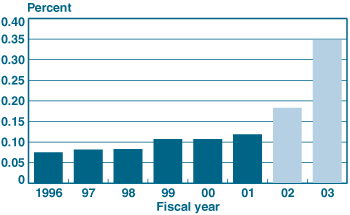 Sources: U.S. Department of Commerce, Bureau of Economic Analysis, National Income and Product Accounts data; 1996 and 1997 data: General Accounting Office (1997); 1998-2001 data: Office of Management and Budget (2001); projections for 2002 and 2003: House Budget Committee and White House press releases; GDP projections for 2002 and 2003: Congressional Budget Office testimony (2002). Sources: U.S. Department of Commerce, Bureau of Economic Analysis, National Income and Product Accounts data; 1996 and 1997 data: General Accounting Office (1997); 1998-2001 data: Office of Management and Budget (2001); projections for 2002 and 2003: House Budget Committee and White House press releases; GDP projections for 2002 and 2003: Congressional Budget Office testimony (2002).
Note: Fiscal years run from fourth quarter to third quarter. |
||||||||||||||||||
|
||||||||||||||||||
Share of National Defense Outlays in GDP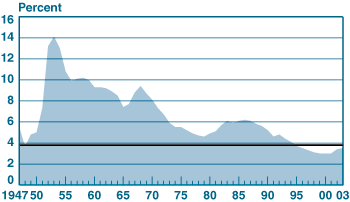
Sources: Congressional Budget Office (2002); author’s calculations. |
||||||||||||||||||
|
||||||||||||||||||
|
Total Annual Direct Costs of Homeland Security
aBased on Congressional Budget Office (2002) estimates of 2003 GDP.
|
||||||||||||||||||
| Disclaimer | ||||||||||||||||||
|
The views expressed in this article are those of the author and do not necessarily reflect the position of the Federal Reserve Bank of New York or the Federal Reserve System. |
||||||||||||||||||

