









| The monthly survey of manufacturers in New York State conducted by the Federal Reserve Bank of New York. |
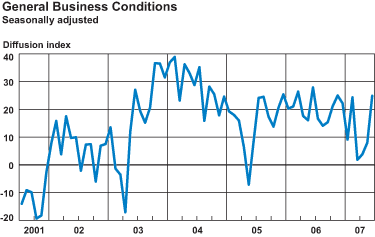
The Empire State Manufacturing Survey indicates that conditions for New York manufacturers improved significantly in June. After three months of lackluster readings, the general business conditions index bounced up 18 points, to 25.8.
The new orders and shipments indexes also rose. The prices paid index climbed several points, while the prices received index fell. Employment indexes were marginally positive. Future indexes indicated a high level of optimism for the six-month outlook, while capital spending and technology spending indexes dropped markedly.
This month, manufacturers were asked a series of supplementary questions about changes in their capital spending plans from 2006 to 2007; similar questions had been asked in the October 2006 survey (see Special Questions tab). Overall, 45 percent of responding firms indicated that they would invest more in capital in 2007 than in 2006, while roughly one in four firms reported reductions in overall capital spending.
The survey results also suggested that, of the broad categories of capital, non-computer-related equipment would see the most widespread increase in investment spending. Sales and demand trends were the most commonly cited driver of both increases and decreases in capital spending in 2007.
General Business Conditions Index Leaps
The general business conditions index surged 18 points, to 25.8, after languishing at relatively low levels in March, April, and May. The June reading returned this index to the high levels that prevailed for much of the preceding year. Forty-three percent of respondents—compared with 26 percent in May—reported that conditions had improved in June, while 17 percent reported that conditions had deteriorated. The new orders index climbed for a third consecutive month, rising 9 points to 17.2, and the shipments index rose sharply from 14.1 to 29.8. The unfilled orders index dipped below zero, to -2.1. The delivery time index was also negative, at -1.1, and the inventories index hovered just above zero at 3.2.
Prices Indexes Move in Opposite Directions
The price indexes indicated that prices were continuing to rise, although the indexes moved in opposite directions. The prices paid index rose from 34.4 to 42.6, suggesting that increases in prices paid accelerated in June. Forty-three percent of respondents reported paying higher prices and none reported paying lower prices. The prices received index dropped from 15.6 to 9.6, indicating that prices received were rising but at a slower pace than last month. Employment indexes were positive, but barely so, with the index for number of employees at 3.4 and the average workweek index at 3.2.
Expectations Remain Upbeat
Future indexes were generally favorable. After rising sharply in May, the future general business conditions index declined somewhat in June. Nevertheless, at 44.1, it remained high compared with its levels over much of the past year. The future new orders and shipments indexes, both around 45, were also at favorable levels. Future price indexes fell: the future prices paid index dropped to 48.9 while the future prices received index fell more sharply, from 36.7 to 21.2. Future employment indexes were positive but below May levels. The capital expenditures index fell markedly from its average level of the past several months, dropping to 18.1, its lowest level in considerably more than a year. The technology spending index also declined, to 18.1.
Firms Indicate Increased Spending on Equipment in 2007
In a series of supplementary questions, manufacturers were asked about their capital spending plans for 2007 relative to their actual spending for 2006, both overall and for a few broad categories of capital. The same questions were asked in an October 2006 survey. In the current survey, 45 percent of responding firms reported increased capital spending in 2007—roughly the same percentage as in last October’s survey—while 25 percent, up from 21 percent in the earlier survey, reported reductions in capital spending.
When queried about spending on certain broad categories of capital, more manufacturers in the current survey reported increases than decreases in investment in equipment—especially non-computer-related equipment—though by a smaller margin than in last October’s survey. Current survey results also point to a modest increase in spending on computer software and little or no change in spending on structures.
Respondents were also asked about the extent to which various factors contributed positively or negatively to their planned changes in capital spending. Slightly more than half of those surveyed cited (improving) trends in sales and demand as a positive contributor, while slightly less than 50 percent indicated a need for labor-saving equipment and long-term (predetermined) investment schedules. The most widely cited factor contributing to a reduction in capital spending in 2007 was (unfavorable) trends in sales and demand, followed closely by unusually high levels of capital spending in 2006—a response that suggested a return to more normal levels of spending.

