









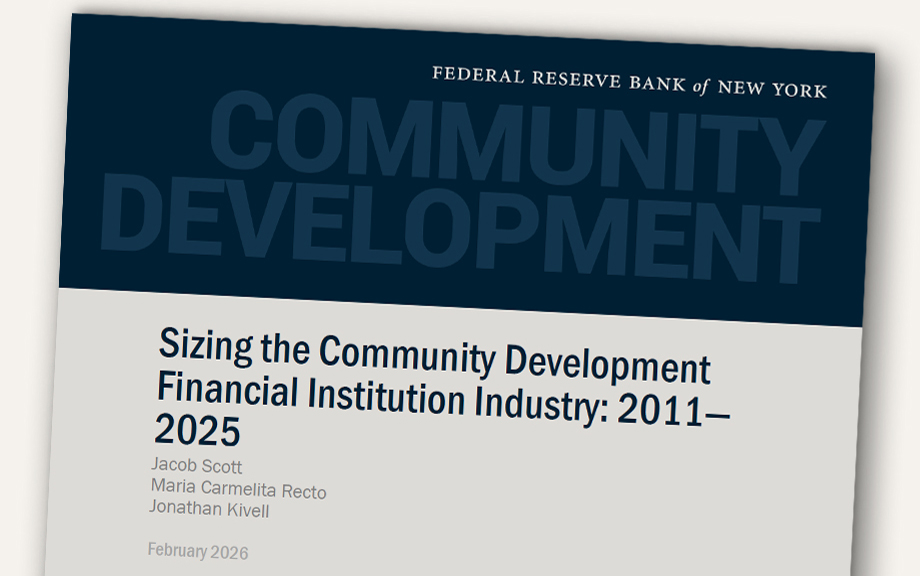
Community Development Financial Institutions (CDFIs) were created to provide financing to households, businesses, and real estate developers in low- and moderate-income communities throughout the country. After growing by nearly ten times between 2011 and 2024, assets held by CDFIs declined modestly between Q4 2023 and Q2 2025.
- The nation’s 1,378 certified CDFI institutions held $446 billion in assets as of Q2 2025.
- CDFI-certified credit unions had assets of $277 billion as of Q2 2025, which is roughly 62% of total assets for all CDFIs.
- Assets held by CDFIs shrank 3% between Q4 2023 and Q2 2025.
- The number of CDFIs declined, falling 6% between Q4 2023 and Q2 2025. Much of the reduction was driven by a decline in the number of CDFI-certified credit unions between 2023 and 2025.
The report is part of the New York Fed Community Development team’s ongoing work on the CDFI industry. It updates a 2023 report, “Sizing the CDFI Market: Understanding Industry Growth,” using more comprehensive data and a longer period of analysis. The team also released a 2024 report, “Examining the Origination and Sale of Loans by Community Development Financial Institutions” and wrote about creating a more robust secondary market for loans originated by CDFIs in a 2024 The Teller Window article.
The Community Development team works to understand the economic experiences of lower-income households and communities to help build a stronger economy for all Americans. Community development is one of the Federal Reserve’s core functions as the U.S. central bank, rooted in the Fed’s mandates from Congress.

